734063, Republic of Tajikistan, Dushanbe, Ayni st., 267

On 10 November 2026, a research article with Dr. Mustafo Safarov, a researcher at the Research Center for Ecology and Environment of Central Asia (Dushanbe), National Academy of Sciences of Tajikistan, as its first author was published in The Cryosphere. The study was conducted in collaboration with scientists from Tajikistan, China, and Switzerland. The journal is published by Copernicus Publications on behalf of the European Geosciences Union (EGU).
The Cryosphere is a leading international peer-reviewed journal specializing in glaciology and cryospheric research. It is indexed in major international citation databases, including Science Citation Index Expanded (SCIE, Web of Science) and Scopus. According to the 2025 SCImago Journal Rank, the journal is classified in the first quartile (Q1) and ranks 3rd among 184 journals in the Earth-Surface Processes category based on SJR. Its SJR and CiteScore values are 2.28 and 7.7, respectively.
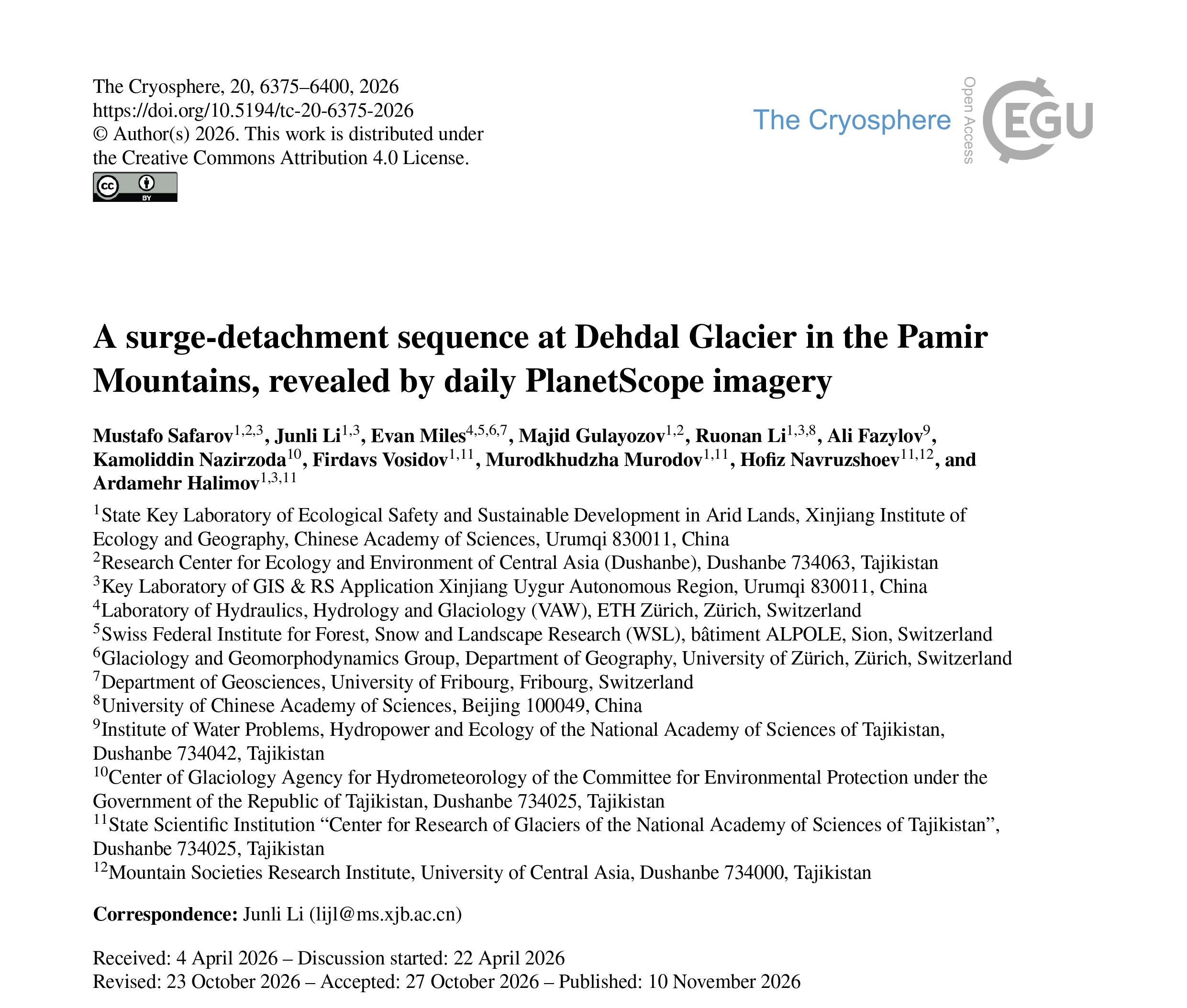
The article, entitled “A surge-detachment sequence at Dehdal Glacier in the Pamir Mountains, revealed by daily PlanetScope imagery,” investigates the complex dynamics of glacier surging and subsequent ice detachment in mountain environments.
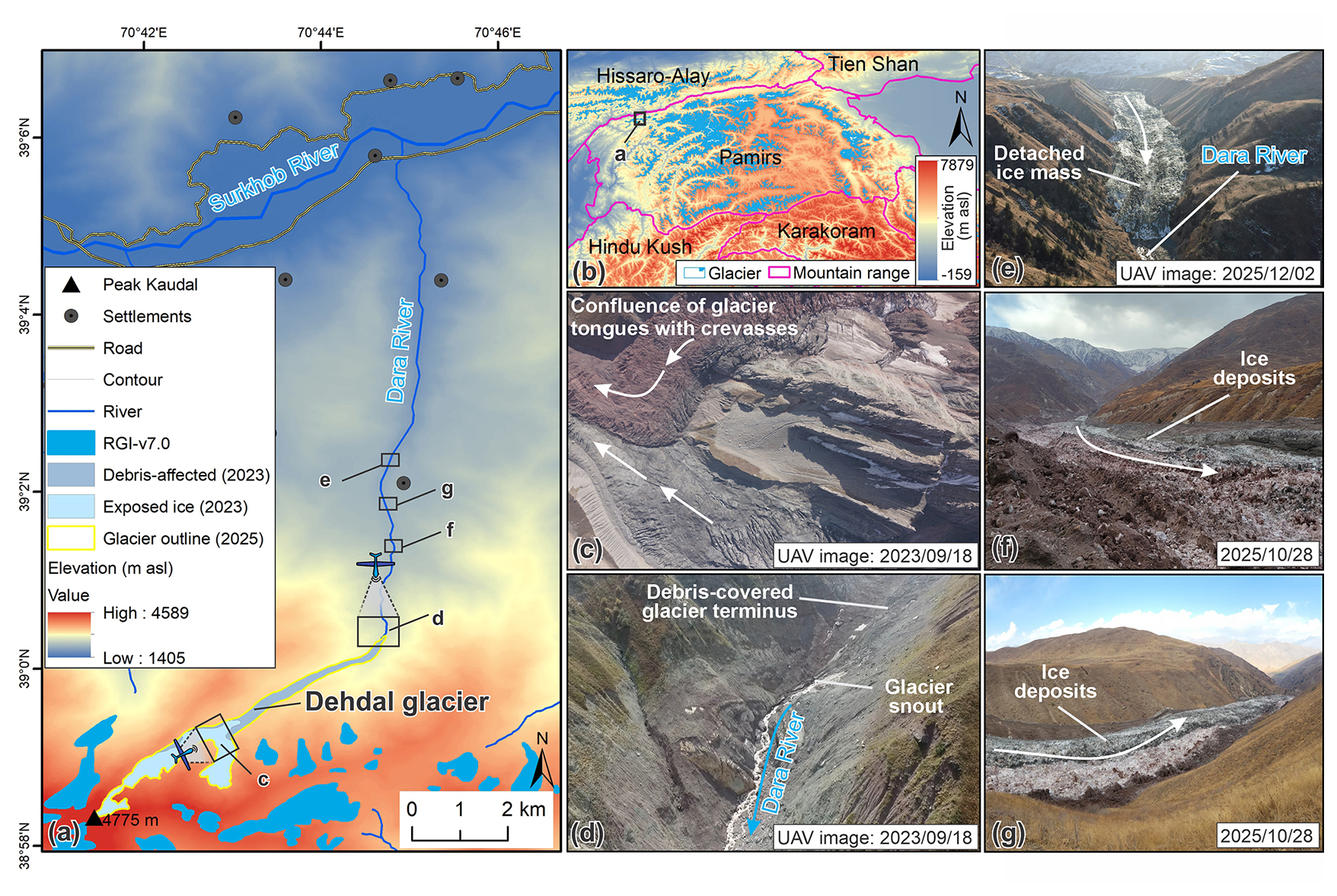
The study focused on Dehdal Glacier, located in the Peter I Range within the Surkhob River Basin of Tajikistan. In September–October 2025, the glacier experienced two successive detachments of substantial ice masses, accompanied by their rapid movement downstream along the Dara River valley.
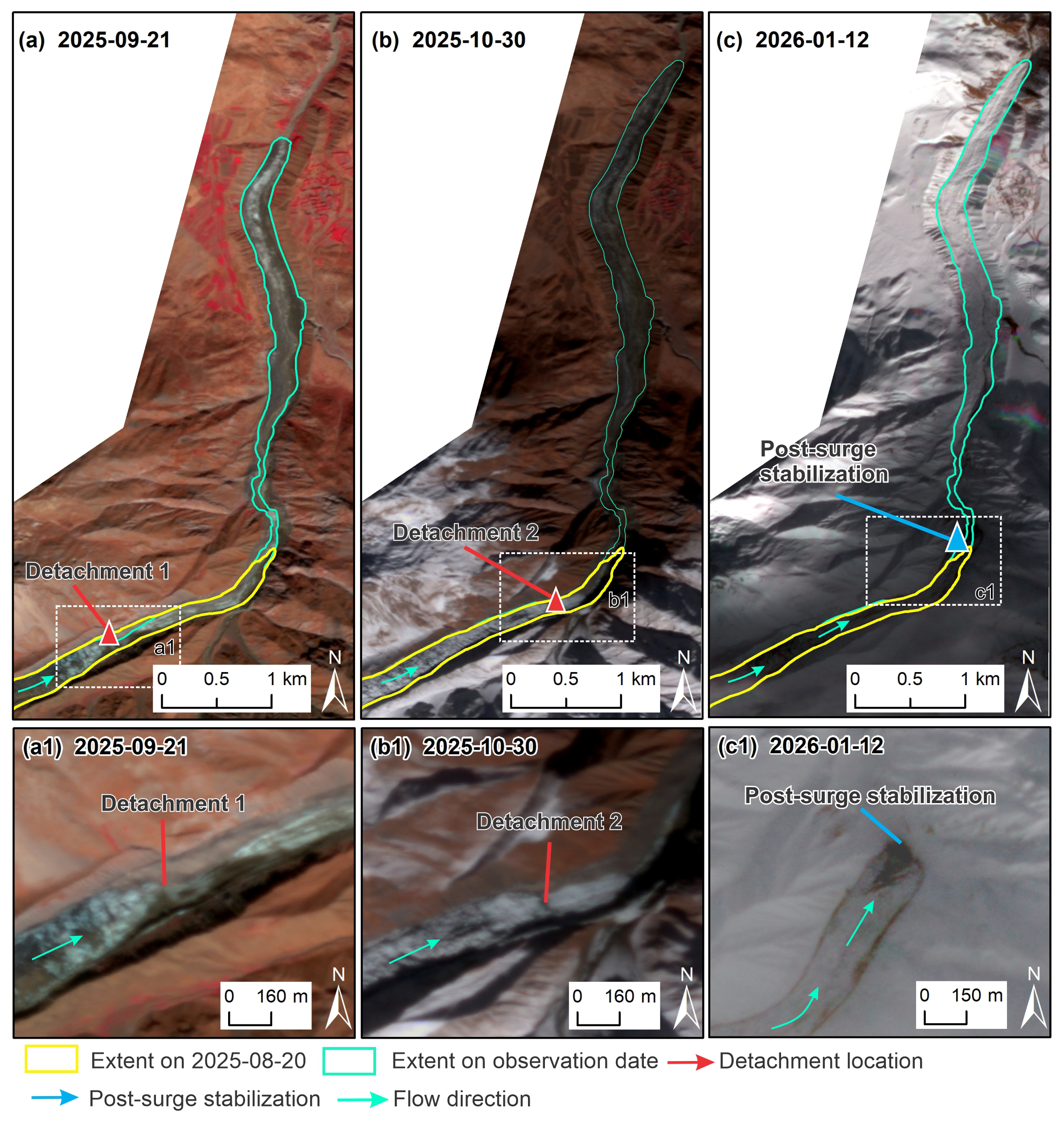
The researchers reconstructed the surge–detachment sequence in detail, from preceding surface deformation and flow acceleration to two successive ice-detachment events and subsequent glacier stabilization. To investigate these processes, the research team combined multi-year field observations, aerial surveys using uncrewed aerial vehicles (UAVs), digital elevation models (DEMs), and 128 high-resolution PlanetScope satellite images selected from June 2025 to January 2026.
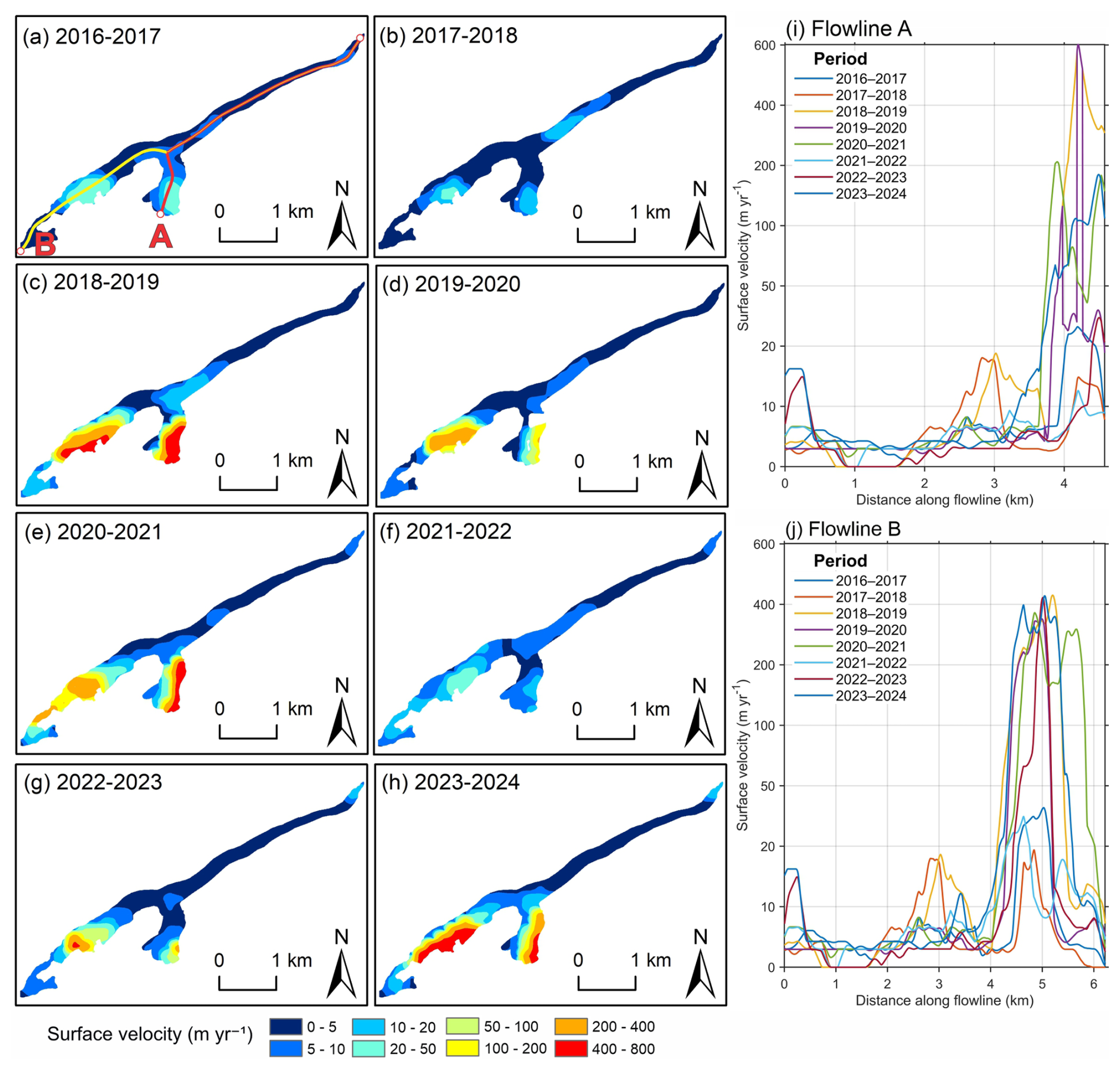
The findings revealed ice-mass redistribution across different parts of the glacier during 2019–2023, followed by surface deformation before the first detachment. After the first event, the glacier tongue became active again, with a substantial increase in ice-flow velocity during the second detachment. These observations show that the events of 2025–2026 involved a complex sequence of glacier surging and ice detachment.
The study highlights that even comparatively small mountain glaciers can cause substantial changes in river-valley morphology and pose potential hazards to downstream settlements and infrastructure. These findings provide a scientific basis for improving the monitoring of surge-type glaciers, investigating glacier-related hazards, and assessing associated risks in the mountainous regions of Tajikistan and other parts of High Mountain Asia.
The full text of the research article is available through the following links:
Official website of The Cryosphere:
https://tc.copernicus.org/articles/20/6375/2026/
ResearchGate:
How to cite:
Safarov, M., Li, J., Miles, E., Gulayozov, M., Li, R., Fazylov, A., Nazirzoda, K., Vosidov, F., Murodov, M., Navruzshoev, H., and Halimov, A.: A surge-detachment sequence at Dehdal Glacier in the Pamir Mountains, revealed by daily PlanetScope imagery, The Cryosphere, 20, 6375–6400, 2026. https://doi.org/10.5194/tc-20-6375-2026